
Somewhere right now, a dispatcher is keying up on the radio. Somewhere a unit is responding. Somewhere a citizen is being helped because two professionals on opposite ends of a radio knew exactly what to say and how to say it. This is an article about that. It is also an article about all the times it goes the other way because it does, and because we can do something about it. If you have spent any time in public safety, you already know radio is a peculiar art form. It rewards brevity but punishes incompleteness. It demands clarity but tolerates almost no rehearsal. The mic, as we call it, goes hot before you have finished thinking. And every shift, somewhere, the channel reminds us all that we still have things to learn.
Here are some of those things, written for the people who live them every day.
The single most useful mental model for a public safety radio channel is this: it is a small room. Everyone who is monitoring is in the room. Everyone hears everyone. There is no quiet corner. There is no private aside. When you key up, you walk to the front of the room and start talking, and everyone else stops what they are saying. That mental model fixes about half of all radio problems immediately. It explains why we listen first because two people cannot stand at the front of the room at once. It explains why we are brief because everyone is waiting for us to sit back down. It explains why we identify ourselves because in a busy room, voices alone are not enough. It explains why we keep things operational because the room is for work, not chatter.
It also explains the special rules around emergency traffic. When someone in the room says things like “I need emergency traffic only,” the entire room stops talking. That is not just etiquette. That is the room’s only mechanism for clearing a path through the noise when someone needs it most. Seasoned dispatchers or trainers may warn newer dispatchers, The radio is not your phone. It is not your text thread. It is the front of a room full of professionals who are all listening at once. Treat it that way, and you will already be ahead of half the trainees who came through before you. Here is one of the great misunderstandings of radio communication: brevity is not about talking fast. It is about saying less. They are different things, and trying to substitute one for the other is the root cause of about a third of all comprehension failures on the channel.
Watch a dispatcher who has been doing this for five, fifteen, or thirty years. Listen to them transmit a long BOLO with five descriptors and a plate number. Then notice something strange: their transmission feels efficient, but it is actually slower than the panicked rookie who just stepped on three other units. The veteran is brief because they include only what is needed. The rookie is fast because they are trying to compress unnecessary content into less time. Same word count, sometimes. Wildly different outcomes.
Before you key up, ask yourself two questions:
- What is the receiving unit going to do with this information?
- What is the minimum I need to say so they can do it?
If you cannot answer the first question, you are not ready to transmit. If you can answer the first but not the second, you have done your homework, but you have not yet found brevity. Keep working.
Codes: Some readers are old enough to remember when 10-codes were how you talked on the radio. Some readers are young enough that they have never used a 10-code in their lives. Both groups have something to learn here. I remember both times well. After 9/11, the federal government took a hard look at why the response to a multi-agency catastrophe had so many communications failures. The answer that came back was uncomfortable: agencies arrived from across the country, all using radio professionally, and they could not understand each other. “10-32” meant one thing in one state and something else two states over. “Code 3” meant urgent in one county and routine in the next. The codes were the problem. The federal response came through the National Incident Management System (NIMS), and it was direct. Plain language for any multi-agency operation. The recommendation has since hardened into something closer to a requirement, with federal grant eligibility increasingly tied to plain-language compliance. Agencies that continue to use codes outside their own four walls may find themselves passed over for federal funding opportunities. That is not an internal preference. That is a budget consequence. I remember a meeting (actually, more than one) trying to get the multiple agencies to switch away from codes. “Your codes work at home. Plain language works everywhere”. The meeting was full of the agency chiefs our PSAP provided service to. Most were very compliant. One outright refused. The transition to plain language was, and in some places and for some people, painful for both sides of the radio, meaning veteran dispatchers as well. Codes were efficient inside an agency. Codes felt professional. There was an unspoken pride in the rapid-fire delivery of “Unit 12, 10-31 at 847 Main, suspect 10-32, code 3.” Plain language sounds longer. Sometimes it is longer. “Unit 12, robbery in progress at 847 Main, suspect armed, respond emergency.” Two extra words. Slightly less crisp. But here is what plain language gives you that codes cannot: a mutual aid unit from three counties over who understands you instantly. A federal agency arriving for a joint operation who understands you. A new hire on day one of OJT understands you. And, perhaps most importantly, the recording of your transmission should it ever appear in court or in an after-action review that needs no translation. Plain language is not a downgrade. It is a different way of optimizing radio traffic. The optimization is for the worst day, not the best. I recall when our dispatch center did a broadcast “all-call” for two officers down after a shooting. And in plain language, everyone knew what that meant, and they came to help; approximately 100 patrol units were on that scene. Yes, that was a separate challenge as well. The incident had a positive ending; both officers survived their wounds, although one was never able to return to work because his wound was so serious. The shooter was caught and served 16 years of a 30-to-60-year sentence.
Bottom line – If your agency has made the switch and you find yourself using a 10-code under stress, here is the trick: just say what the 10-code means. “10-32” becomes “armed.” “Code 3” becomes “emergency, lights and sirens.” “10-50” becomes “motor vehicle accident.” In every case, the plain-language version was originally what the code meant. We just abbreviated it. To convert back, you reverse the abbreviation. It does not require a new vocabulary; it requires using the vocabulary you already have.
There is one rule on the radio that supersedes brevity, supersedes plain language, supersedes every other guideline in this article. It is this: “If it changes how a responder approaches the scene, it goes in the transmission.” If the caller mentioned a weapon, the word “weapon” goes in the transmission. If the caller said “hurricane fence with a Doberman behind it,” the word “Doberman” goes in the transmission. If the caller mentioned a known mental health condition that has been documented at the address before, that history goes in the transmission. If the call originated from a property with a prior history of barricaded subjects, that history goes in the transmission.
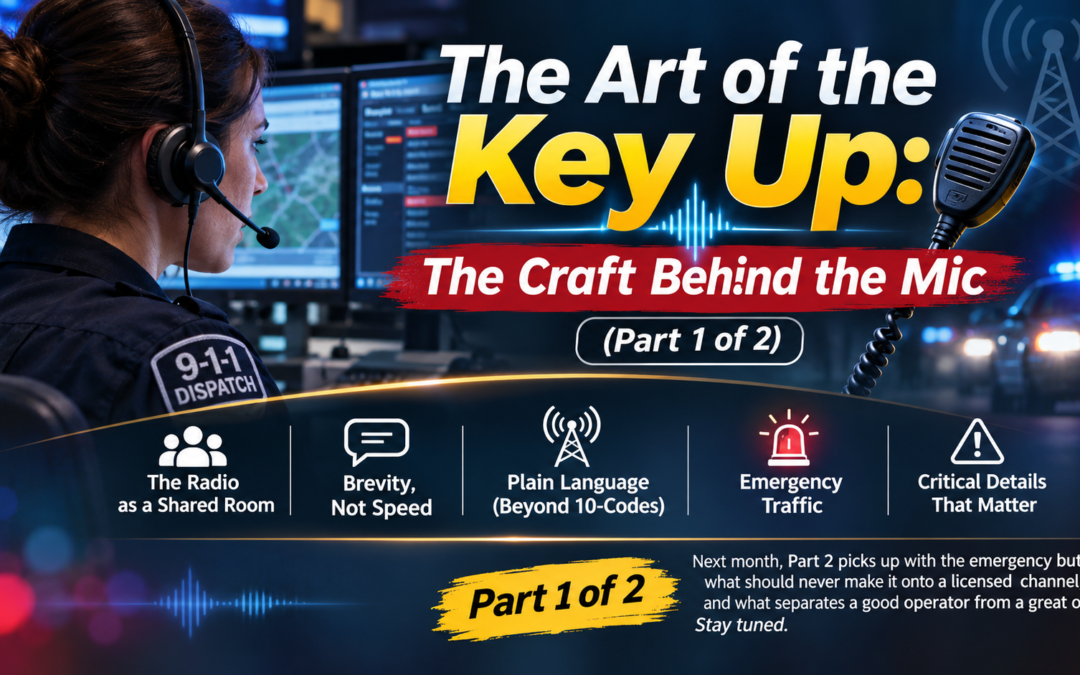
This is Part 1 of a two-part article. Next month, Part 2 picks up with the emergency button, the short list of things that should never make it onto a licensed channel, and what separates a good operator from a great one. Stay tuned.
Recent Comments