
A resource for public safety professionals, supervisors, and agency leadership
When I was a director, my dispatchers came to me with a request. They wanted a comfort animal in the center — a dog, a cat, maybe even a fish tank full of fish. They were passionate about it. They kept asking. And I listened, because that’s what directors do.
But then I started asking questions. Who was going to walk the dog between calls? Who was cleaning the litter box — and when? Who was maintaining the fish tank? I looked around at the break room and thought about the microwave that nobody could seem to keep clean for more than a day, and I wondered: if we can’t manage that, what happens to a living creature that depends on us? What happens to the program when the one person who cared most about it puts in their two weeks’ notice? And what about the dispatcher at console four who sneezes the moment a cat enters the room? In the end, when I said no, they stopped asking. Not because the idea was bad. But because nobody had done the work to answer the hard questions — and without answers, even the best intentions aren’t enough to build a program on.
That experience stayed with me. Because the idea itself — that an animal’s presence might soften the weight of what dispatchers carry every single day — isn’t wrong. The research says so. And a growing number of agencies across the country are proving it can be done. But the difference between a program that works and one that quietly collapses — or worse, creates new problems — comes down entirely to preparation.
When a Golden Retriever named Donut started making rounds through the Brevard County Sheriff’s Office communications center in Florida, dispatchers who had spent years fielding calls about child abuse, overdoses, and officer-involved shootings said something changed in the room. The tension didn’t disappear — it never does in a comm center — but for a few minutes at a time, it softened. People exhaled. Some cried. Some laughed. All of them, by their own accounts, felt a little more human.
That story is not unique. Across the country, law enforcement agencies, emergency communications centers, and first responder organizations are quietly exploring what many in the mental health field have studied for decades: that the presence of an animal in a high-stress environment can meaningfully reduce physiological and psychological stress markers. But the road from “good idea” to “sustainable program” is longer and more complicated than it might appear — and the 911 center presents a unique set of challenges that no other workplace quite matches.
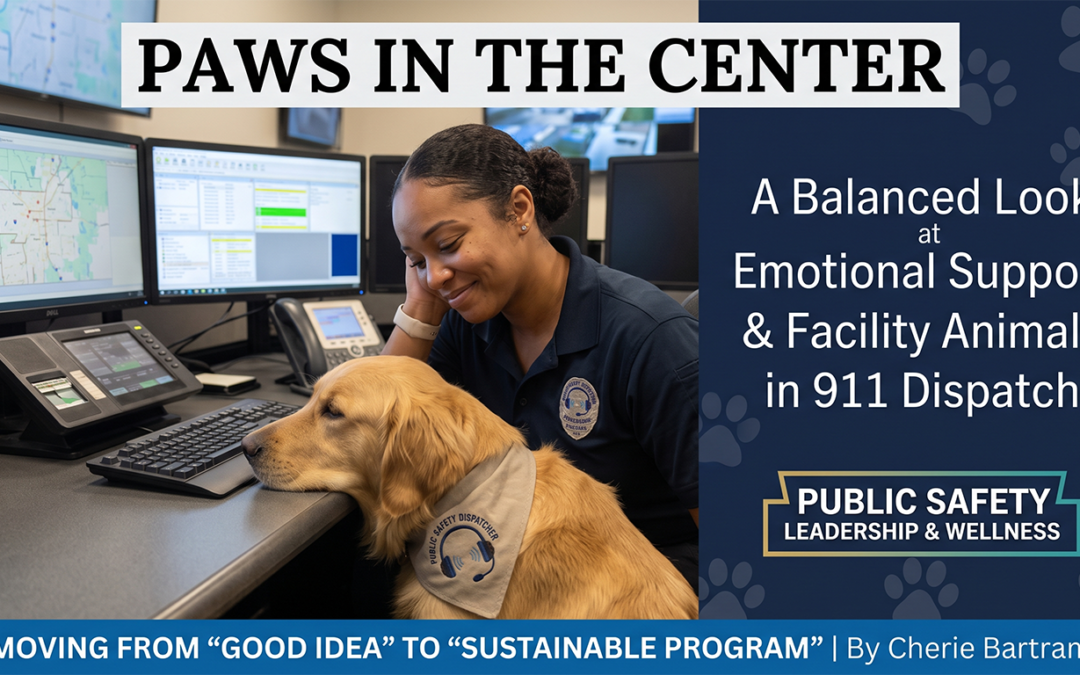
This piece takes a balanced look at all sides: the research, the real-world examples, the benefits, the risks, and the hard questions every agency needs to answer before a single paw crosses the threshold.
What the Research Tells Us
The science behind human-animal interaction (HAI) is more robust than many administrators expect. Studies published in peer-reviewed journals have consistently shown that interacting with a calm, trained animal — even briefly — can:
- Reduce cortisol (the primary stress hormone) levels measurably within minutes
- Lower blood pressure and heart rate
- Trigger the release of oxytocin, the hormone associated with bonding and emotional regulation
- Reduce self-reported feelings of anxiety and emotional exhaustion
A 2019 study published in AERA Open found that even brief, unstructured interactions with therapy dogs produced significant reductions in stress among college students during high-pressure periods. Similar findings have emerged from hospital settings, veterans’ programs, and crisis counseling environments.
The application to 911 professionals is logical. Dispatchers absorb trauma secondhand on every shift — the screaming parent, the dying officer, the child who doesn’t understand what is happening. Compassion fatigue, vicarious trauma, and burnout are not hypothetical risks in this profession. They are occupational realities. Any evidence-based tool that helps mitigate those effects deserves a serious conversation.
While formal academic research specifically on therapy animals in 911 centers remains limited, a number of agencies have moved from conversation to implementation — with documented results.
Brevard County Sheriff’s Office — Viera, Florida. One of the more well-known examples in public safety, Brevard County introduced a therapy dog program that included visits to their communications center. The program was part of a broader peer support and wellness initiative. Staff reported that the animal’s presence during high-call-volume periods provided an emotional reset that other wellness tools had not achieved.
Pasco County Sheriff’s Office — Florida Pasco County has been recognized for its comprehensive approach to dispatcher wellness, which has included animal-assisted support components. Their model emphasized that wellness is not a perk — it is an operational necessity, directly tied to dispatcher performance and retention.
Reno Police Department — Reno, Nevada The Reno PD introduced a facility dog named Kyra, a trained Labrador Retriever, available to officers and support staff, including communications personnel. Kyra was owned and managed by a designated handler within the department, went home with that handler each evening, and was covered under the department’s insurance umbrella. The program was structured carefully to address liability and allergy concerns before launch.
San Diego Humane Society & Law Enforcement Partnerships — California Several San Diego-area agencies partnered with the Humane Society to bring certified therapy animals into first responder facilities on a rotating basis — rather than a permanent assignment — which helped manage allergy and logistical concerns while still delivering wellness benefits.
Crisis Call Centers & NENA-Affiliated Agencies The National Emergency Number Association (NENA) has increasingly spotlighted dispatcher mental health as a priority. Several NENA member agencies have cited animal-assisted wellness as part of their multi-layered approach to staff resilience, particularly in the post-pandemic period when burnout rates spiked dramatically across the profession.
The Case For: Why is this conversation worth having with your staff and rule makers? Proponents of animal-assisted wellness programs in 911 centers make several compelling arguments that go beyond “it feels good.”
- Retention and Morale: As all in public safety are aware, retention and morale are in crisis. The dispatcher workforce is shrinking. Agencies across the country are reporting vacancy rates of 20–40%. Anything that demonstrably improves the work environment and signals that leadership takes dispatcher wellness seriously is not a soft benefit — it is a recruitment and retention strategy.
- EAP and Perceptions: In addition, traditional EAP programs are underutilized and as we have discussed in some of our previous articles, may not be a right fit if the counselors are not properly exposed to the PSAP environment to understand what is at stake. Studies consistently show that first responders severely underuse Employee Assistance Programs. Stigma, distrust, and the perception that seeking help signals weakness all contribute. An animal in the workplace is non-stigmatizing. Nobody has to sign a form or call a hotline. They just pet the dog.
- The cost-to-benefit ratio is favorable. When compared to the cost of recruiting and training a new dispatcher — often estimated at $10,000–$25,000 per hire when training time is factored in — the cost of a well-structured therapy animal program is modest. Particularly when structured through a nonprofit partnership where ownership and veterinary costs remain with an outside organization. These programs also signal a cultural shift. For agencies trying to move from a “tough it out” culture to one that treats psychological health as seriously as physical safety, a visible wellness initiative sends a message. It tells dispatchers: we see what this job costs you.
The Case Against: What Critics and Skeptics Raise
A balanced look requires honest engagement with the concerns, and those concerns are real!
- Allergies and Medical Expense: As I mentioned, my concern was allergies, and then there is the real concern of the medical accommodations, which create legal risk. This is the most frequently cited operational concern, and it is legitimate. Under the Americans with Disabilities Act and most state equivalents, an employee with a documented allergy or a documented phobia of animals may have a valid accommodation claim. When two employees’ accommodation needs conflict, there is no automatic winner — and the resolution process can be lengthy, expensive, and damaging to workplace relationships. Agencies that launch a program without a documented allergy accommodation protocol are taking on unnecessary legal exposure.
- The 911 environment is not a typical workplace. Therapy animals thrive in calm, predictable environments. A 911 center during a major incident — active shooter, multi-vehicle accident, structure fire — is neither calm nor predictable. Loud alarms, shouting, sudden bursts of radio traffic, and extreme emotional volatility can be distressing for an animal and disruptive if handlers are managing a stressed animal during a critical event. The animal’s welfare must be as carefully considered as the staff’s.
- Ownership, liability, and continuity are complicated. Who owns the animal? If the designated handler leaves the agency, what happens to the program? If the animal bites a visitor or an employee, who carries the liability? If the animal becomes ill or dies, how does the agency manage the grief of staff that has bonded deeply with it? These are not hypothetical edge cases — they are questions that have derailed programs in agencies that did not address them in advance.
- Not everyone wants this. Some employees will be indifferent. Some will actively object — on the grounds of allergies, personal discomfort, religious beliefs, or simply preference. A program implemented without staff input can create division rather than unity, and can be perceived as a leadership decision imposed on the floor rather than a benefit developed with the people it is meant to serve.
- Veterinary and care costs are ongoing. Even in a well-structured program where ownership rests with a nonprofit partner, there are costs: veterinary bills, food, grooming, certification renewal, and the handler’s time. In tight municipal budgets, these costs can become politically visible and difficult to defend — particularly if the program’s outcomes are not being formally measured.
The Hard Questions Every Agency Must Answer First
Before a therapy or emotional support animal program is approved, leadership should be able to answer the following clearly and in writing:
Ownership & Responsibility
- Who legally owns the animal?
- Who is the designated handler, and what happens if they leave?
- Who pays veterinary bills, food, grooming, and certification costs?
- Is the animal covered under the agency’s general liability insurance?
HR & Legal
- Has the agency’s legal counsel reviewed the program for ADA compliance?
- Is there a written accommodation protocol for employees with allergies or animal phobias?
- Is there a policy governing the animal’s presence in specific areas of the facility?
- Have union representatives (where applicable) been consulted?
Animal Welfare
- What is the animal’s certification and training level?
- Who monitors the animal’s stress levels and has the authority to remove it from the environment?
- Where does the animal go during major incidents or high-intensity periods?
- What is the plan for the animal’s retirement or death?
Program Structure
- Will the animal be present daily, or on a rotating/scheduled basis?
- Has staff input been formally gathered before implementation?
- How will the program’s effectiveness be measured over time?
- Is there a defined trial period with an honest evaluation built in?
Models That Have Worked
Agencies that have successfully implemented programs tend to share a few common characteristics:
Nonprofit partnership model. The agency partners with a certified therapy animal organization. The organization retains ownership and liability. The animal visits on a schedule — perhaps two or three times per week — rather than being a permanent resident. This eliminates many of the ownership, cost, and liability questions while still delivering the benefit.
Designated handler with clear expectations. Where an animal is assigned full-time to a facility, the most successful programs designate a trained staff handler who takes the animal home, provides daily care, and manages the animal’s welfare during work hours. This role is formalized in writing, not informal.
Phased introduction. Successful programs typically start small — a trial period with formal staff feedback at 90 days. This allows issues to surface and be addressed before the program is fully embedded.
Transparent policy before day one. Every concern — allergies, animal-free zones, incident response protocols — is addressed in a written policy before the animal arrives. Staff know the rules. HR knows the rules. The handler knows the rules.
Terminology – It is worth clarifying the distinctions between types of animals in this space, as the terms are frequently used interchangeably but carry different legal and practical weight:
A therapy animal is trained and certified to provide emotional support to people in institutional settings. It is not the personal pet of the person it supports, and it does not carry the same legal protections as a service animal.
An emotional support animal (ESA) is prescribed by a licensed mental health professional to a specific individual and provides support to that person. ESAs are not trained for public or institutional work and are generally not appropriate for a shared workplace environment.
A facility dog is a highly trained animal, often with the same foundation training as a service dog, assigned to a specific facility and handler. Facility dogs are typically the most appropriate and sustainable model for a 911 center. For most 911 center programs, the facility dog or visiting therapy dog model is the most legally sound and operationally practical choice. The difference between reading that on paper and witnessing it in person, however, is something no policy document can fully capture. I have personally witnessed the power of a visiting therapy dog after a tragedy involving PSAP personnel. You could feel the tension and sorrow lessen in the room as the dog made her way from person to person, sniffing each outstretched hand with light doggy kisses and a wagging tail.
The Bottom Line -The idea of an animal in a 911 center is not a gimmick. It is a response to a documented crisis in dispatcher wellness — one that traditional tools have not fully addressed. The research supports the concept. Real agencies have made it work. And the dispatchers who have experienced it, by and large, say it made a difference.
But good intentions do not substitute for good planning. The agencies that have succeeded did the hard work first: the legal review, the policy development, the allergy protocols, the handler agreements, and the insurance questions. They brought staff into the conversation before a decision was made. And they committed to measuring whether it was actually working.
For any agency considering this path, the message is not don’t do it. The message is: do it right. Because a program that fails — or worse, one that triggers an ADA complaint, a union grievance, or an animal welfare incident — does more damage to dispatcher wellness than no program at all. The goal is a healthier workforce. The animal is just one possible tool in getting there. Used thoughtfully, it can be a powerful one.
Sources and further reading: Journal of Human-Animal Interaction; NENA Dispatcher Health & Wellness resources; APCO International wellness guidelines; American Veterinary Medical Association (AVMA) guidelines on animal-assisted interventions; ADA National Network guidance on workplace accommodation conflicts.
Cherie Bartram is the Education Program Director at Equature. She believes that animal-assisted wellness programs in the PSAP could be beneficial as long as the hard questions are satisfactorily answered prior to moving forward with the program.