
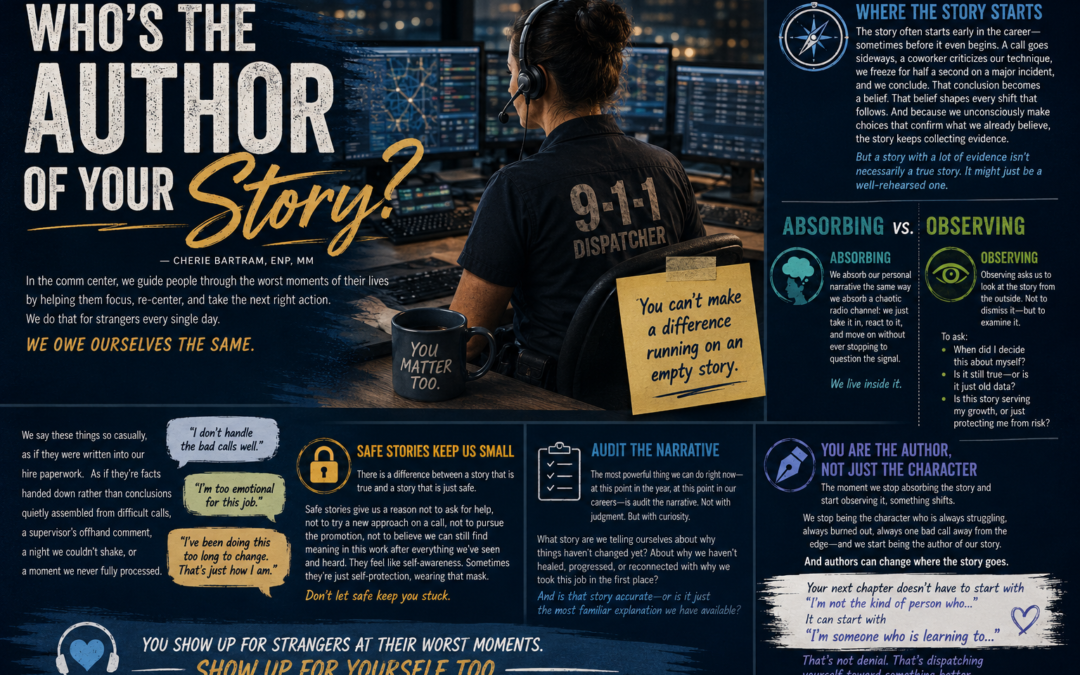
Leesa Ferrell works at Equature and sends out amazing reminders to the staff each week to keep us grounded and focused. She sent out an email about being our own unreliable narrators in our own lives recently and I was captivated. I decided to pass the story on with this view to the world in the PSAP because I have watched so many 911 personnel at every level inaccurately author the story of their lives, and I am including myself on that list. Why do we do it? Not because we’re dishonest. But because we’ve been telling certain stories for so long, we stopped questioning whether they’re actually true. They became the background noise running beneath every shift — quiet, constant, and unquestioned.
I don’t handle the bad calls well. I’m too emotional for this job. I’ve been doing this too long to change. That’s just how I am.
We say these things so casually, as if they were written into our hire paperwork. As if they’re facts handed down rather than conclusions quietly assembled from difficult calls, a supervisor’s offhand comment, a night we couldn’t shake, or a moment we never fully processed.
Where the Story Starts
The story often starts early in the career — sometimes before it even begins. Something happens: a call goes sideways, a coworker criticizes our technique, we freeze for half a second on a major incident, and we conclude. That conclusion becomes a belief. That belief shapes every shift that follows. And because we unconsciously make choices that confirm what we already believe, the story keeps collecting evidence. It starts to feel airtight. But a story with a lot of evidence isn’t necessarily a true story. It might just be a well-rehearsed one.
Absorbing vs. Observing
In 911, we are trained to process information rapidly and make fast decisions. That same instinct — when turned inward — can work against us. We absorb our personal narrative the same way we absorb a chaotic radio channel: we just take it in, react to it, and move on without ever stopping to question the signal. When we absorb a narrative — I always freeze under pressure, I’m not cut out for this, I can’t disconnect at home — we stop seeing it clearly. We live inside it. We make decisions from within it without ever stepping back to the console and asking whether it deserves the authority we’ve given it. Observing asks us to look at the story from the outside. Not to dismiss it — some of our narratives are rooted in real calls, real trauma, real patterns. But to examine it. To ask:
- When did I decide this about myself?
- Is it still true — or is it just old data?
- Is this story serving my growth, or just protecting me from risk?
Safe Stories Keep Us Small
There is a difference between a story that is true and a story that is just safe.
Safe stories give us a reason not to ask for help, not to try a new approach on a call, not to pursue the promotion, not to believe we can still find meaning in this work after everything we’ve seen and heard. They feel like self-awareness. Sometimes they’re just self-protection, wearing that mask.
The most powerful thing we can do right now — at this point in the year, at this point in our careers — is audit the narrative. Not with judgment. But with curiosity. What story are we telling ourselves about why things haven’t changed yet? About why we haven’t healed, progressed, or reconnected with why we took this job in the first place? And is that story accurate — or is it just the most familiar explanation we have available?
You Are the Author, Not Just the Character
In the comm center, we guide people through the worst moments of their lives by helping them focus, re-center, and take the next right action. We do that for strangers every single day.
We owe ourselves the same.
The moment we stop absorbing the story and start observing it, something shifts. We stop being the character who is always struggling, always burned out, always one bad call away from the edge — and we start being the author of our story. And authors can change where the story goes. That means you can change where your story goes. Your next chapter doesn’t have to start with “I’m not the kind of person who…”
It can start with “I’m someone who is learning to…”
That’s not denial. That’s dispatching yourself toward something better.
You show up for strangers at their worst moments. Show up for yourself too — because you can’t make a difference running on an empty story.