
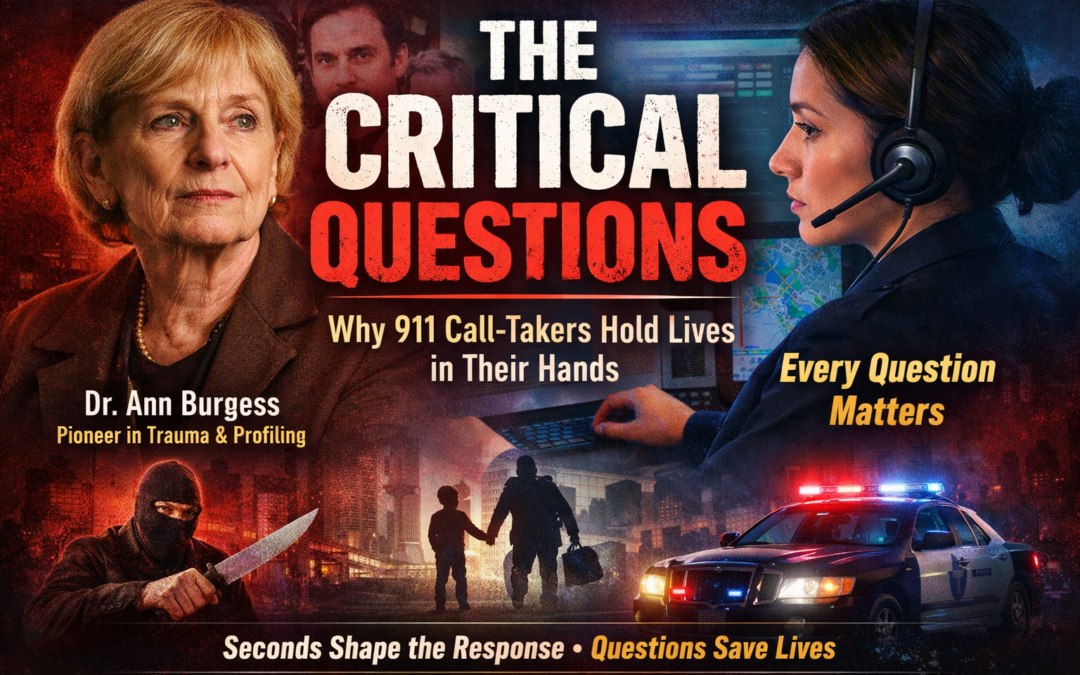
The Critical Questions: Why 911 Call-Takers Hold Lives in Their Hands
Jan 2, 2026
I ran across a crime documentary, which led me down a path on a remarkable woman named Ann Burgess. Dr. Burgess is known for her work that focused on questions for victims of trauma and abuse, specifically sexual assault in the early 1970’s. Her backstory is that she was nearly a victim of rape in the 60’s, back when men were the only investigators, and the thought was that if a woman was raped, it was only because they wanted “it”. Or the victim must have dressed in a manner that made the man want them, so they “deserved” it, and because they dressed that way, ultimately they must have wanted “it”. I remember growing up back then. I remember being scared that if someone ever raped me, I would never tell because it wouldn’t matter, no one would believe me. Along comes Ann Burgess, who escapes being a victim of a sexual assault, receives a nursing degree, and goes on to get a doctorate as a board-certified psychiatric clinical nurse specialist. She decides that she wants to help women who have been traumatized by sexual assaults by letting them know she believes THEM through her questioning methods and showing them that she knows they did not want “it” and she pioneered the treatment of trauma in rape victims. The FBI noticed her methods and brought her to Quantico in the 70’s to teach new FBI agents. Her first class, described as a big group of men, snickered at her on the first day because they all believed that women really wanted “it”. But she changed all of that. HOW AMAZING IS THAT!?! She went on to assist as an FBI consultant and helped develop modern psychological profiling for serial rapists and killers. She was instrumental in putting away noted rapist John Simoninos (ski mask rapist), who confessed to 81 sexual assaults, although the FBI theorized that Simonino’s actual number of reported assaults is closer to 120 reported assaults. Simoninos admitted that he was escalating toward homicide had he not been caught. His capture was obtained by shifting the interview techniques and asking his victims the right questions. Dr. Burgess was involved in the interviews with Ted Bundy, Charles Manson, the Menendez brothers, and even the Bill Cosby case, just to name a few of the other high-profile cases.
She changed the world simply by starting a change in the way questions are asked of sexual assault victims because of her own life experience. Pause on that for a moment. You have a life experience, and you think, I’m going to dedicate my life to helping others through this experience. Dr. Burgess was not only instrumental in changing the mindset of what a sexual assault victim was and was not, but she also assisted in the successful arrest of serial criminals through her careful questioning of the victims. Her life is amazing, and it was this that caused my deep-thinking brain to reflect on my career in 911 and the job that thousands of you do every day, and how truly important the questioning skills are when we answer the 911 emergencies. When a panicked voice reports a kidnapping or sexual assault, the next 60 seconds of conversation can mean the difference between a rescue and a tragedy. For 911 call-takers, asking the right questions in the right order isn’t just protocol—it’s a life-saving skill that determines how quickly help arrives and whether responders walk into a dangerous situation prepared.
In time-critical emergencies like kidnappings, robberies in progress, and just-occurred sexual assaults, the information gathered in those first moments shapes the entire response. A child abducted by a non-custodial parent could be crossing state lines within the hour. A sexual assault victim may still be in immediate danger if the perpetrator hasn’t left the scene. A robbery suspect fleeing on foot creates a narrow window for apprehension before they disappear into a neighborhood or vehicle.
Our questions become so critical that some questions are really pointless and waste time. The order of the questions, which may not seem important, is equally critical, getting the most valuable information available first and relayed to responders. Call-takers must rapidly extract vital details while maintaining caller composure. Where exactly did this happen? When—seconds ago, minutes ago? Is the suspect still present? Are there weapons? What direction did they go? What were they wearing? Vehicle description and license plate? These aren’t checklist questions—they’re tactical intelligence that shapes whether patrol officers arrive in time to intercept or merely take a report.
The Questions That Matter
For kidnappings, the initial questions establish whether this is a stranger abduction, family abduction, or lost child—each requiring dramatically different responses. Was force used? Is the child in a vehicle now? Amber Alert criteria hinge on these details, and delays in gathering them can mean missing the narrow window when such alerts are most effective. The National Center for Missing and Exploited Children is loaded with information on questions to ask, how to ask them, and steps to take. (National Center for Missing & Exploited Children). I highly recommend checking them out and researching how to become part of the missing kids readiness program. (Missing Kids Readiness Program)
For just-occurred sexual assaults, call-takers face the delicate balance of gathering critical information while supporting a traumatized victim. Is the victim safe now? Is the suspect known to them? Are there injuries requiring immediate medical attention? The presence of weapons, whether the assault occurred in a residence or vehicle, and whether the suspect made any statements about returning—these details inform both the urgency and the approach of responding officers.
In robbery calls, the distinction between a crime in progress and one that just occurred changes everything. Is the suspect still inside the business? Armed with what type of weapon? How many suspects? Which direction did they flee? The answers determine whether officers set up a perimeter, whether K-9 units are deployed, and whether helicopters are launched.
You Make The Difference!
What makes this work so demanding is that call-takers must gather this information from people in crisis—terrified victims, witnesses who are confused, bystanders who saw only fragments. The skill lies in asking questions that are specific enough to generate actionable intelligence but simple enough for a panicked person to answer. It requires empathy without sacrificing urgency, calmness that reassures without minimizing the crisis.
Poor questioning has consequences. Vague locations delay response times, but so do asking and re-asking the same question because the caller is unable to answer. Ask your questions twice (or follow your agency policy) and move on to the next question. Just make sure your responders know when you are unable to obtain critical information due to an upset or emotional caller. The responders need to know what information may be lacking or vague because it puts them at risk when they arrive in the area “blind”. Failure to identify weapons puts first responders at risk. In the worst cases, incomplete information means a preventable tragedy unfolds while help is still trying to figure out where to go.
The best 911 call-takers understand that their questions are the foundation of the entire emergency response. They’re not just gathering information—they’re building a tactical picture in real-time, one question at a time, knowing that the right question asked at the right moment can save a life. This is why you stayed in this line of work, for these calls. This is when you make the difference. You don’t have to have a PhD. You just have to remember that what you do matters and to do your best, every time.
I spent most of my adult life in the PSAP. Training has improved and standardized over the years. The questions we ask, when we ask them, what not to ask have changed since I started out in the 1980’s, and honestly, thank goodness for that! Not that the training back then was bad, but our profession was new, and we know so much more now than we knew then. The importance of this cannot be stressed enough. I clearly did not go the path of Dr. Burgess; I have not changed the world, but I still hope to make a difference every day. I believe that every day, PSAP personnel throughout the world are making a difference when they answer the phone, when they ask the right questions, when they send the right help. Although I am not in the PSAP, I am excited that I get to be part of the Equature team because being on the team, I still get the chance to make a difference, to help.
How, you may ask. This article is not about Equature, but we are expanding our Apprentice training program with an immersive 911 simulator that puts you in the hot seat—handling kidnappings, assaults, robberies, and critical calls that demand split-second decision-making. Build your skills with real-world scenarios before lives depend on it.
New courses. New pricing. Game-changing preparation.
Ready to train smarter? Check us out: Equature | AI-Powered 911 Recording & Transcription Software. We have great courses available and new ones about to be released that specifically teach about the caller mindset!
Want to learn about our instructor team or learn more about our training? Reach out directly—I’d love to talk! Cherie Bartram
Recent Comments