
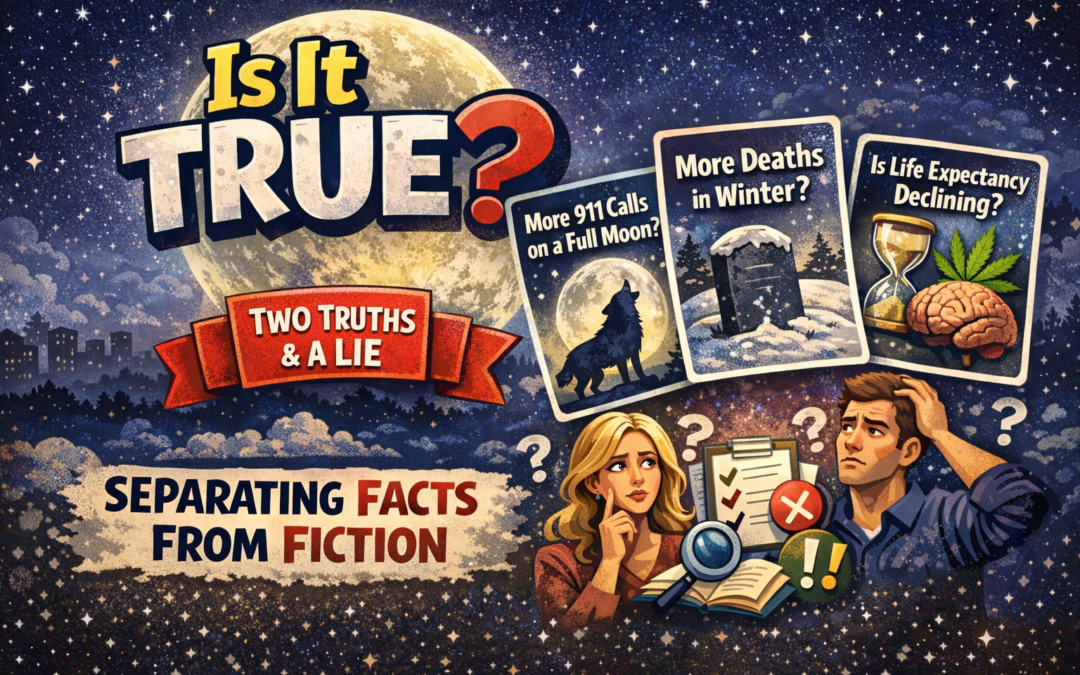
Is It True?
As our kids grew up over the years, we often played two truths and a lie. We sometimes switched it up and played it differently but it always made me laugh, a bit uneasily sometimes at the outrageous things the kids would say that I thought was a lie, that wasn’t, but we made it a safe way to learn about each other.
This game was brought to my mind as I was pondering unrelated topics this past week. Topics that impact the public safety world in terms of call volume as well as our own personal knowledge base. Information I had heard but thought deserved more of a look at as I wondered, truths or lies?
- Is It True – That There Are More 911 Calls During a Full Moon?
The first one is one that most of us know well. Is it true that there are more 911 calls during a full moon? In keeping with the spirit of the “game” this is a “lie”. While the perception may feel like it’s true, there has been research on this topic.
A study analyzing 8,415,412 EMS activations found no significant difference in daily averages between full moon periods and non-full moon periods, with 33% of calls occurring during full moon periods. (Shekhar et al., published in American Journal of Emergency Medicine, 2022 (Document 2-1). Research from multiple studies found that when these claims were examined closely, they fell apart, and crime does not increase when there is a full moon.
For law enforcement calls, the research is contradictory, but leans toward no effect. A multi-agency study analyzed 59 months and 972 police shifts across three medium-sized law enforcement agencies, examining various crime types including domestic violence, assault, disorderly conduct, drunkenness, robbery, breaking and entering, larceny, and shoplifting, and found that police activity was not significantly greater during the full-moon phase.( Office of Justice Programs study, 59 months analysis (Document 2-1).
Another study in 2016 found that the intensity of moonlight suggested that better lighting helped criminals see their surroundings rather than any other lunar influence. (Outdoor crime illumination study, 2016 (Document 7-1)
There was even a study on the broader belief that the full moon has a strong affect on human behavior despite the lack of statistical evidence. I worked the console for 15 years before being promoted to leadership and another 24 years in leadership. I would be with you if you were in this category.
The research suggests that this belief persists because there are at least five nights every 28 days that either are or could be mistaken for a full moon, making it very likely that one of these nights will be busy, and emergency workers tend to remember the times it was busy when there was a full moon while not noting quiet full moon nights. Hmmmm… So statistically speaking, this is going to remain NOT TRUE. (https://elifesciences.org/digests/35500/winter-months-remain-deadlier-for-older-us-adults)
- Is It True, Are There More Deaths in The Winter?
My son is a career Marine. For two years of his career he served in a special position of funeral duty (NOT the correct military term.) When the winter months came he was very busy with funerals. He said there were more deaths in the winter than summer. I thought, hmmm is it true? As it turns out, yes, it is true.
Deaths among women and men aged 45 or older peaked between December and February, largely caused by respiratory and heart diseases or injuries, with deaths in this older age group being lowest during summer months. (Parks et al., eLife Science Digests, 2018 (Document 11-1)).
In Britain, month-to-month variation accounted for 17% of annual all-cause mortality among people aged 75 and older, with an overall winter to non-winter rate ratio of 1.31. (Wilkinson et al., BMJ population-based study (Document 12-1)).
Seasonal mortality variation in heart attack deaths increased with age: 5.8% for those under 65, 8.3% for ages 65-74, 13.4% for ages 75-84, and 15.8% for those over 85 years.(PubMed study on increased winter mortality from acute myocardial infarction (Document 14-1)).
In public safety, these statistics mean those welfare checks in the winter have a higher probability of being an unattended death. More cardiac arrests, more emotional incoming calls you may have to take. It also may translate to your own family. Why would I mention that? Only to make sure that you are taking care of yourselves.
Getting the rest you need, eating properly, getting some sunshine, and exercising, even if that means you only can be active for ten or fifteen minutes each day. Any activity is better than none. Taking care of you during the winter months, is even more important in order to keep your wellbeing as healthy as possible.
- Is It True That Longevity Is Going Backwards
When I was in my mid-twenties, I remember hearing of a study that was released that my generation would experience, for the first time ever, a reverse in longevity due to health issues. That study was released nearly 40 years ago and while I thought of it now and then, I didn’t dwell on it much until about five years ago, when a couple of my high school classmates passed away from cancer. Then, the news stories would have this or that person pass away with heart attacks or cancer, and they were around my age.
So, in my pondering of these deep questions this week, I thought I would look this up. Is it really true, now that I am the age I am, IS Life expectancy in the United States moving backwards? The answer is YES.
Life expectancy in the United States has decreased by 1.5 years from 2019 to 2020 to the lowest level since 2003, with men declining from 76.3 to 74.5 years and women declining from 81.4 to 80.2 years, representing the largest one-year drop since World War II. Life expectancy fell from nearly 79 years in 2019 to 77 in 2020 and dropped further to just over 76 in 2021, representing the largest decrease over a two-year span since the 1920s, with COVID-19, drug overdoses, and accidental injury accounting for about two-thirds of the decline.
But wait, more disturbing news. There is substantial scientific evidence linking diet, particularly ultra-processed foods—to decreased life expectancy. Research from the NIH-AARP Diet and Health Study tracking more than half a million adults ages 50 to 71 for almost 23 years found that people who consumed significant amounts of ultra-processed food were 10% more likely to die, especially from heart disease and diabetes, during the study’s two-decade follow-up period.
A study published in JAMA Internal Medicine following almost 45,000 adults ages 45 and older found that after nine years, there was a direct statistical connection between higher intake of ultra-processed food and a higher risk of early death from all causes, especially cancers and cardiovascular disease. (JAMA Internal Medicine study, 2019 (Document 3-1)).
A 2024 review of 45 meta-analyses covering nearly 10 million study participants found convincing evidence that a diet high in ultra-processed foods increases the risk of death from cardiovascular disease by 50% and the risk of anxiety by 48%, with highly suggestive evidence of a 66% increased risk of death from heart disease and a 21% increase in early death from any cause. (Stanford Medicine/BMJ review of 45 meta-analyses, 2024 (Document 7-1)). Research showed that for every 10% increase in ultra-processed food consumption, there is a 2.4-month increase in the gap between biological and chronological age, evidence that ultra-processed food intake may accelerate biological aging. (NHANES biological aging study (Document 8-1)).
The last sad factor is obesity as a mediating factor. Rising obesity rates in the United States are slowing life expectancy gains, and obesity may be accelerating biological aging by more than two years faster among nonsmoking individuals with obesity, contributing to earlier onset of chronic disease, disability and death. One study found that U.S. life expectancy at age 50 in 2006 was reduced by 1.28 years for women and by 1.61 years for men as a result of obesity. (NCBI analysis of international obesity comparisons (Document 13-1)).
I know, what does this have to do with us? EVERYTHING! Let’s go back to the winter mortality ending.
I spent a lot of years in dispatch folks. I know how hard it is to eat right. I know how hard it is to exercise. You’re tired. You want the pizza, chicken, donuts, and my big downfall, cookies!
But this is our life we’re talking about. Processed foods are killing us, alongside our own habits of too many sweets and lack of movement. We can fix this one! You already know what to do! In fact, check out Kerry O’Connel’s early blog about this: https://store.equature.com/small-changes-that-make-a-big-impact/.
This leads me to the last pondering point. I know – this is more than 2 truths and a lie – but I wondered about this so I had to research it too.
- Is It True That Marijuana Changes Brain Patterns?
I thought, can this be true? I hear people say. “How?! It’s legal!. It’s just like alcohol” Oh, but there is a difference. This one is true, but complex.
Chronic marijuana use showed lower structural connectivity, and there was a quadratic trend suggesting that structural connectivity initially increased following regular marijuana use but decreased with protracted regular use, indicating differential effects that may reflect complex neuroadaptive processes.
So what is chronic use? It is defined by most studies as ongoing, consistent marijuana use, up to daily and for an extended period of time which could be months up to years. Someone can be considered a chronic user if they consume cannabis five to seven times a week. So if someone uses once in the morning, once at night two or three times per week, they would be considered chronic.
A heavy user is someone who consumes enough cannabis to lead to intoxication on a regular basis for months or years. (King Palm health information (Document 3-1)). Regular cannabis use was associated with gray matter volume reduction in these areas of the brain: “medial temporal cortex, temporal pole, parahippocampal gyrus, insula, and orbitofrontal cortex, though existing literature shows that cognitive alterations and CB1 receptor”(Harvard Health citing American Journal of Psychiatry study, 2022 (Document 27-1)).
Downregulation may return to normal values due to neuroadaptive phenomena occurring after periods of abstinence. Individuals who used cannabis long-term and heavily exhibited impairments across several domains of cognition, with IQs declining by 5.5 points on average from childhood, and deficits in learning and processing speed, though individuals who used cannabis less than once a week with no history of developing dependence did not have cannabis-related cognitive deficits. (Harvard Health, citing American Journal of Psychiatry study, 2022 (Document 27-1)).
Key nuance: The changes are not necessarily “permanent” – some research indicates reversibility with abstinence, though heavy long-term use does show persistent alterations. (CDC Cannabis and Public Health page (Document 30-1)).
What does this mean to public safety? In a world where agencies may be struggling with the zero-tolerance policy viewpoint or the approach of it’s legal but it can’t be in your system if you’re at work, this may be helpful information. To each agency, this subject must be made from an agency-specific perspective, but these facts can help make you think about the topic deeper.
I’ve always been “accused” of being a deep-thinker. Playing games while you “deep think” is a fun way to explore topics and find out more about the world around you. Feel free to deep-think with me! If there is a topic you would like to explore, a podcast or webinar you would like to see, or a course you would like us to have in our Apprentice portal, feel free to reach out to me at: Cherie Bartram. I would enjoy hearing from you.